Mitosis
Mitosis
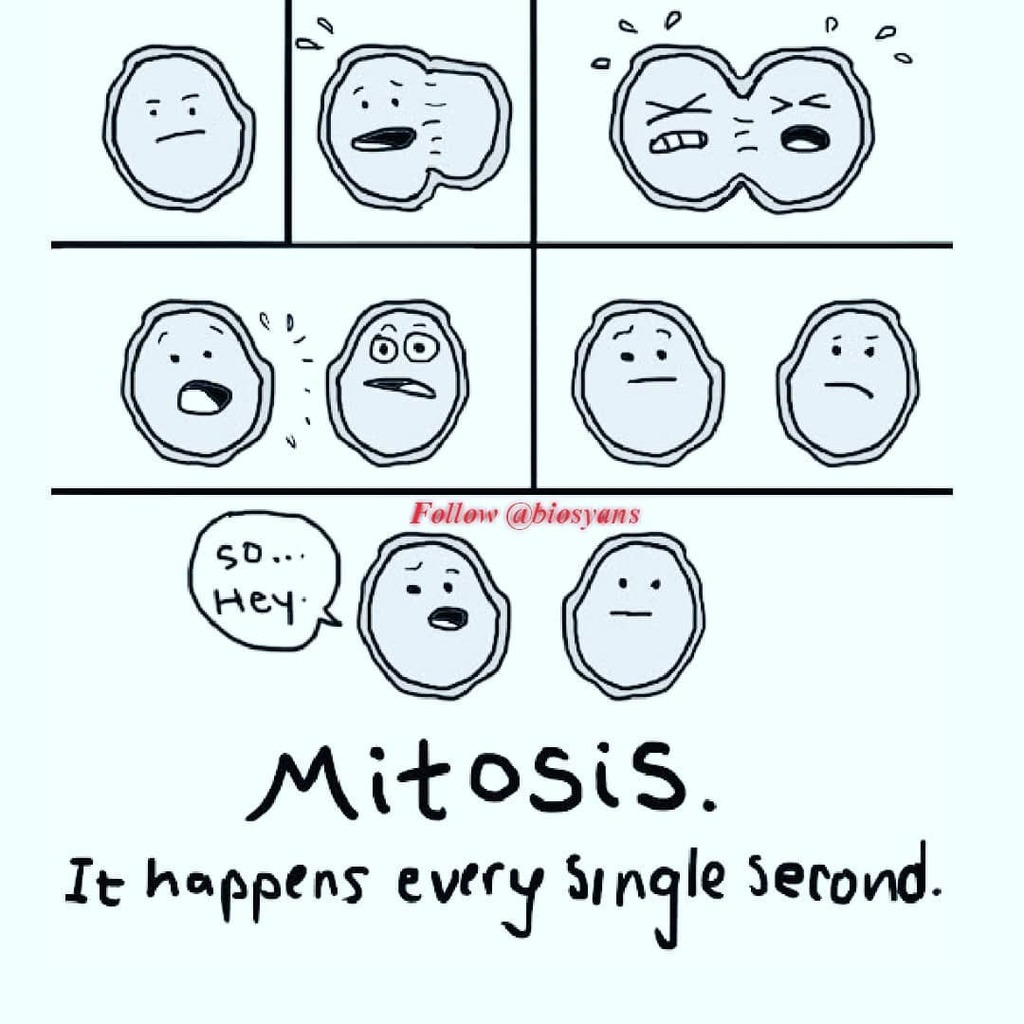
Many people learn about mitosis when they are in middle school, the first time I remember learning about mitosis was in 7th grade, and then I learned about it again in high school biology. So, it's not something that you probably have no idea what it is, but there is much more to it than you probably think! So, first I am going to go over the basics. What is mitosis? Mitosis has to do with the things we see in everyday life! The plants we see, the intestines in our body, the birds you see, and so much more all are made of cells, and go through mitosis. Mitosis is the process where a cell replicates its chromosomes and then segregates them, making two identical nuclei in preparation for cell division. Mitosis is generally by equal cell division of the cells content into two daughter cells that have identical genomes. To break it down even more you could say this, it is like making copies of an instruction manual. Copy each page, and then give one copy to every two people. In mitosis, a cell copies each chromosome, and then gives a copy to each two daughter cells. When making the copies of the instruction manual, make sure that it is copied word for word and that there is no grammar problems. If you do that then it would be hard for the people to follow the instructions if they can't read it. This is the same for mitosis, each cell needs to receive exactly one copy of each chromosome, and each copy needs to be perfect, no mistakes or the cell will have trouble following the genetic instructions. The cells have amazing systems to copy chromosomes almost perfectly and to make sure one copy goes to each daughter cell. There still are some mistakes that can take place when copying or dividing cells, it is very rare but still possible. This can result in some hard consequences for the person and the cells. :max_bytes(150000):strip_icc()/stages-of-mitosis-373534-V5-5b84992cc9e77c00574f03d3.png)
Prophase
Now that we got the basics of this out of the way, we can get more in depth with the phases and how they work! There are five different phases that go into mitosis, I know you're probably thinking that sounds like a lot, but I promise once you get them down, they all come together and make sense. The first phase of mitosis is prophase. During this phase, chromosomes recruit condensing and undergo a condensation phase. I know that may sound confusing, so I'll explain it more. It is the first and longest phase in mitosis. During this, chromatin condenses into chromosomes, and the nuclear envelope (the membrane around the nucleus) breaks down. In animal cells, the centrioles near the nucleus begin to separate and move to opposite poles of the cell. Centrioles are small organelles found only in eukaryotic cells that help ensure the new cells that form after cell division each contain a complete set of chromosomes. As the centrioles move apart a spindle starts to form between them.

Comments
Post a Comment